


Revolutionary vertical air cargo hub is five years away

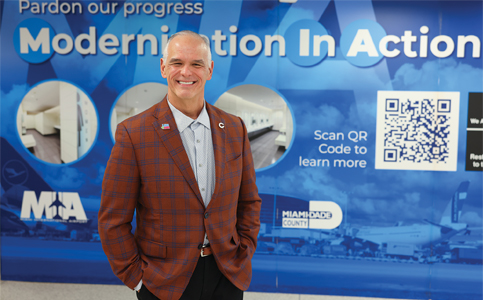
A revolutionary vertical center that will increase Miami International Airport’s cargo capacity by 50% is working through 18 months of due diligence before construction can begin, with actual operation of the center still five years away, aviation officials say.
A 40-year lease for Miami Gateway Partners to spend $400 million to develop and then operate the cargo center on the airport’s property won county commission approval last July. The airport requires an 18-month period for environmental impact, land surveying, logistics, and sorting out other technicalities.
From that point, the partnership would begin design and construction phases, with the cargo center estimated to be operating by 2030.
The public-private partnership is with Miami Gateway Partners, itself a joint venture between Airis Aviation Group and Vantage Airline Partners. The partnership has agreed to design, build, operate, and maintain the vertically integrated cargo center. Aviation Director Ralph Cutié said the project will significantly increase airport cargo capacity as the first cargo operation of its kind in North America.
“We just finished up the year with our fifth straight record-breaking year in cargo numbers, so nearly 3 million tons this year,” Mr. Cutié told Miami Today. “Three million tons is very close to our capacity, our overall cargo capacity for the airport. We need to be able to grow our capacity so we can continue to grow our operations and to accommodate any new cargo company that wants to come and to fly with us.”
Mr. Cutié said Miami International currently transports the most international freight in the United States, as well as the third-most total freight and total cargo, and currently ranks sixth worldwide in international freight, total freight, and total cargo.
“We’re one of the premier cargo airports in the world, and we want to continue being that,” he said.
Mr. Cutié said the new site would increase MIA’s cargo capacity by 1.5 million tons, putting it 11 years ahead of projected trends in cargo shipping increases.
“It allows us to grow our projections for the future,” he said. “We’re supposed to be at about 4 million tons of actual cargo by the year 2031, and we’re supposed to be at nearly 5 million tons by the year 2041. It’s important that we start planning now for that future growth in cargo, so that we can accommodate it, and again, maintain those rankings and even improve on them.”
Construction on the site, set to begin next year, is estimated to create 8,000 to 8,500 temporary jobs, as well as an additional 3,000 to 3,500 permanent jobs once the cargo center opens. The workers would be employed by Miami Gateway Partners as the hub’s operators.
Once operational, the airport would collect rent on the cargo center as well as 7% of the center’s gross revenue, with operators charging the cargo carriers for the revenue. According to Mayor Danielle Levine Cava, MIA is set to collect $512 million over the course of its 40-year lease.
MIA is also currently partnered with others to support its cargo growth while the project is being completed. Atlas Air, for example, is currently expanding in a two-phase project, and Avianca Airlines, which handles a majority of perishables entering the US, is growing capacity.
According to Mr. Cutié, the new vertical facility will handle all cargo, including perishables, with cold storage facilities to preserve flowers, fruit and vegetables, fish, and all other sensitive cargo.
“As the design develops, the mix of how much is handled – how much is regular cargo, how is perishable – all that will be taken care of as the design moves forward,” he said.
The vertical facility will rise on 11.3 vacant acres, precious real estate on MIA’s 3,300 acres, most of which is occupied by the main airport.
County officials say they’re confident in the project’s success and estimate it will have a tremendous financial and logistical impact for Miami-Dade County.
“MIA continues to increase its cargo rankings among airports in the US and worldwide,” said Mayor Daniella Levine Cava. “With the construction of this unprecedented, state-of-the-art air cargo facility now on track, the sky is the limit for where MIA can lead the air cargo industry globally after consecutive record-breaking years in cargo growth since 2020.”
The vertical cargo hub, she said, “will have a massive local economic impact … and a minimum of $512 million in rent and business revenue to Miami-Dade County’s Aviation Department over the 40 years of the agreement.”
According to Mr. Cutié, other major airports throughout the United States, such as John F. Kennedy International Airport in New York and Los Angeles International Airport in Los Angeles, are also considering adding cargo hubs of this nature, which would significantly alter cargo processing in the US.
“It’s going to be the first project of its type in the Western Hemisphere, if not North America,” he said. “It’s a very complex project, so it’s going to involve a lot of moving parts, so we need to make sure any potential hurdles are addressed … so that’s why it takes a little time, but the project is moving along.”
“This type of vertical cargo handling,” he added, “may end up revolutionizing over time how cargo is handled here in the US.”



Recent Comments