


Innovative national model shapes micro-freight downtown

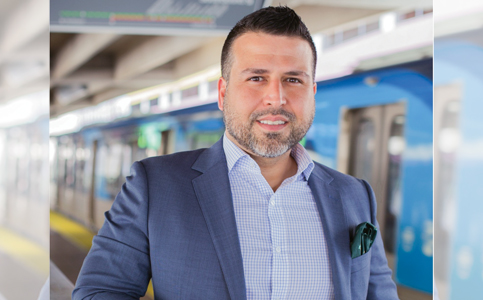
In an innovative program that’s creating a national model, microfreight is enroute this year to Downtown Miami and Overtown.
Cameras and sensors will be put in place first in order to “gather data and establish the program and then … this summer we should start seeing some of these cargo bikes and trikes,” said Carlos Cruz-Casas, chief innovation officer for the county’s Department of Transportation and Public Works.
The cargo bikes look like an “elongated bicycle with an electric motor to it with a box either front or back,” said Mr. Cruz-Casas. “There is a really interesting type of vehicle that London has been using, where it looks like a small truck … like UPS small trucks, Amazon small trucks, but it’s a bicycle and four wheels. So, we’re going to be pursuing and looking for options to introduce those types of vehicles around here.”
In 2023, the Department of Transportation and Public Works received $1.98 million through the US Department of Transportation’s Strengthening Mobility and Revolutionizing Transportation grant program for infrastructure projects.
“It’s really interesting to see … the federal government is actually looking to cities in Miami-Dade County, in this instance, to actually innovate and bring solutions that can be replicated and basically shared with others,” said Mr. Cruz-Casas. “Miami-Dade County is part of a collaborative of … cities that have decided to basically work on something very similar …. The goal for us is actually to apply technology, community engagement [and] identifying what’s the future of deliveries in an area like Downtown Miami and share with others throughout Miami-Dade County and around the nation.”
“Microfreight is a term that we’re trying to coin here,” he said. “There’s a lot of conversation about micro mobility, micro transiting other elements and what we’re looking into is … right-sizing the vehicle that delivers goods in an area like Downtown Miami.”
A few years ago, said Mr. Cruz-Casas, Downtown Miami “created a network of separated protected bike lanes, three and a half miles that we now have available in Downtown Miami.”
Although this enhanced safety for those who use the lanes, it has created a challenge for businesses, said Mr. Cruz-Casas. The curb space that was once used for delivery pickup or drop off is now used by pedestrians and cyclists.
“Our approach was, can we still think about safety using microfreight,” said Mr. Cruz-Casas. “So, if we’re able to prototype and incentivize deliveries by cargo bikes, delivery robots and things like that, folks can still get their deliveries and continue to thrive in our community like Miami-Dade County, and we can continue to build bike lanes. That’s kind of the standard premise.”
Initially, said Mr. Cruz-Casas, people will see a “combination between technology data, community engagement and basically describing what the future for mobility and freight mobility in Miami-Dade County will be in the sense that you will see cameras on the curb zones with some technology that can identify the current utilization of some of these curb zones, understanding that not every single delivery can be delivered by bikes.”
The department has also partnered up with Urban Health Partnership [UHP] a local nonprofit that focuses on community engagement and people skills, said Mr. Cruz-Casas. “They created a program that’s called the Community Liaison Program, where instead of me going out to the community and talking to them about technology, they work together with the community, hire local folks from the community from Overtown and Downtown Miami, train them with the communication skill, train them with the technology knowledge, and they’re the one that go out and communicate.”
UHP will essentially “be the boots on the ground and cover working with the community, whether it’s the general public or the businesses, to better understand their needs and see how this new approach can be delivered appropriately,” he said.
The department is on a mission to start reducing emissions, he said. “[When] we think about zero emission, the first thing we can do is actually change the way we do things. Put those deliveries on bikes, put these deliveries in shared rides or other elements you’ll be able to do, and the last thing to do is electrify the rest of the fleet. So you’re going to see a lot of benefits hopefully by introducing these vehicles to the ground. We’re starting with bikes because it’s a larger capacity than a delivery robot.”
The grant establishes what is called the Micro Free Commons Platform, said Mr. Cruz-Casas. “What that is, is a digital tool that we have access to, in which we’re going to be able to create the rules on how the microfreight should operate within the area. We do that through something called the API, the application protocol interface, which is how systems communicate with each other.… Ultimately Miami-Dade County through the Open Mobility Foundation helped develop and basically now completely adopt across 300 cities across the world something that’s called the mobility data specification, which is basically a standard way of communicating rules of engagement.”
Locations around the globe have begun the same efforts to work toward more eco-friendly options.
“There were eight of us that came together and applied for this grant,” said Mr. Cruz-Casas. “All eight got the grant award, which tells us … we’re on the right track and the federal government is actually really valuing the input of local cities towards this innovative approach for our community.”
Safety, partnerships, equity and access are some of the outcomes trying to be achieved, said Mr. Cruz-Casas.
“Our collaborative includes cities like San Francisco, Seattle, Portland, New York and a couple other places,” said Mr. Cruz-Casas. “We all experience the same thing in one way or the other.”
As technology is installed in the streets, he said, signs will be placed describing what it is.
If the program is successful, he said, “areas like Miami Beach, or Coral Gables, areas like some of these other places throughout Miami-Dade County, can be next in terms of leveraging these new business models, new ways to deliver, and hopefully continue to grow.”



DC
March 6, 2024 at 8:04 am
So these bikes are manned or unmanned, i.e, robotic? That wasn’t clear because there was no mention of hiring “drivers.”
DS Lamb
March 6, 2024 at 3:10 pm
Why not use mail delivery vehicles…that already exist? 1.98 million dollars could be better spent elsewhere. Enough with untested frue frues and apply the money to providing decent bus service to ALL the people who are adding 2 hour commutes to their workday because of poor planning and an aversion to asking and ACTING on what the residents ask for.
John Dohm
March 7, 2024 at 4:50 pm
Micro-fulfillment, micro freight delivery. and micro-mobility have been successfully used and adopted all over the world from New York to the UK, and Singapore to Scandinavia. Little or no carbon footprint and greatly improved access for all, especially the elderly and home-bound. It is easily tested and scaled, leverages emerging technologies, and improves safety for everyone. Plus, the goods that can be carried by hand and on mass transit are extremely limited.
Kudos to Miami for adopting the best of what globalization has to offer.