


Farmlands’ critical mass in danger zone, University of Florida finds

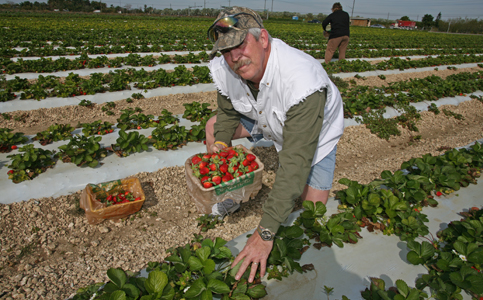
Miami-Dade’s agricultural industry, which a century ago fed the nation in winter with vegetables and fruit, is in danger of hitting a critical point where it doesn’t have enough farmland to remain viable, a county-commissioned report by the University of Florida warns.
The county, which still had 120,000 acres of farmland in 1959, had only 58,606 acres identified as agriculture for tax exemptions in 2017 and 78,543 farmland acres identified in the census. The university’s more than 400-page report says a minimum 64,800 farmland acres will be needed in 2030 to remain economically viable as land is rapidly siphoned to other uses.
As it is, the vast majority of the farmland that once filled train boxcars headed north with vegetables and fruits is shifting rapidly to produce nursery plants and ornamentals, which fill 35% of the farmland. Vegetables still grow on 38% of the farmland and fruit orchards on 27%, the report found.
The county’s farms still ship 89% of their yield to the Northeast, the central US and Canada, “bringing dollars into the local economy that stimulate additional economic activity,” the report says. In 2017, the US Department of Agriculture found that the county had 2,752 farms with sales of $830 million on 78,543 acres and $3.25 billion in farm assets.
But since that census, a memo from Mayor Daniella Levine Cava emphasizes, the county lost more than 10% of its farmland in just six years, a trend that if it continues threatens the industry’s viability to remain relevant as a farming area.
The county commission ordered the report in May 2022, authorizing the agreement with the university to document economic trends associated with the county’s major crops, pinpoint factors that can keep the industry profitable and sustainable, identify emerging technologies that can help keep agriculture strong, recommend ways to improve the industry’s economic sustainability, and project land needs for 2030, 2040 and 2050.
The study did find that emerging technologies including salmon aquaculture, which is expanding rapidly near Homestead, labor efficiencies and other changes can keep the industry relevant on less land in the future – but not much less land. The estimate of minimum needs was 64,800 acres in 2030, 60,900 in 2040 and 56,300 in 2050.
The county’s Comprehensive Development Master Plan land use map designates 69,072 acres for agricultural use in both 2030 and 2040, the mayor’s report says. “When farmland is converted to development,” her report says, “it’s nearly impossible to convert it back to agriculture.”
The university made five broad recommendations for county policy to maintain a strong industry that now employs 12,836 workers full and part time.
They are:
■Maintain current land use policies using the Urban Development Boundary to control urban development, limit low-density rural development, maintain open space for agriculture and limit urban sprawl.
■Lobby state and federal governments for “more favorable international trade agreements that safeguard domestic agriculture from international competition.”
■Work at the state and federal levels for an agricultural guest worker program that’s less burdensome than what’s now available.
■Maintain strong county support for agriculture.
■Work with state and federal regulators “to consider changes in water management regulations” associated with heavy rainfall and sea level rise.



Recent Comments