


As new building rises, Miami votes to stay in historic city hall

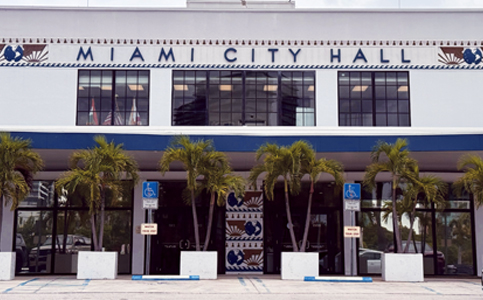
Miami City Hall is to remain in its historic waterfront home in Coconut Grove, preserving the site as the city’s primary civic meeting place even as other municipal offices prepare to move elsewhere.
The Miami City Commission voted 4-1 last week to keep regular commission meetings and City Hall at 3500 Pan American Drive, directing the city manager to continue using the Dinner Key property for those functions. The decision maintains the building as Miami’s legislative home while the city continues developing a new administrative headquarters near Miami Freedom Park to consolidate its broader municipal workforce.
Built in 1934 as a Pan American Airways seaplane terminal, the Art Deco building was designed by architects William Adams Delano and Chester Holmes Aldrich. After Pan Am ended its operations at Dinner Key in 1945, the city acquired the property in 1946 and adapted it for civic use, establishing City Hall there in 1954.
Commissioner Damian Pardo, who sponsored the resolution, said the building represents more than its location in Coconut Grove, tying the city’s present government to Miami’s history as a critical point of connection between the United States and neighboring countries.
“We have 70 years of history, of legacy, in this building,” Mr. Pardo said. He pointed to the site’s origins with Pan Am, which operated routes from Dinner Key to the Caribbean and South America. “That defines what we became,” he said, adding that Miami’s identity as the “gateway to Latin America” continues today.
The commercial seaplane terminal became a major hub for international air travel during Pan Am’s early operations. At the time, it was recognized as the largest and most modern marine air terminal in the world and became a model for terminals later built in New York, San Francisco and Rio de Janeiro. The building was listed on the National Register of Historic Places in 1975.
Commissioner Miguel Gabela, whose district includes the new administration complex, cast the lone dissenting vote. He said he agreed with Mr. Pardo’s appreciation of the historic building but questioned the decision after the city had already spent taxpayer money on a new facility designed to house its government operations.
“The problem is that we just spent money on a supposedly new city hall that some of us approved about two or three years ago,” Mr. Gabela said. “How many city halls are [we] going to have?”
Mr. Gabela said he was concerned about what the decision would communicate to taxpayers, particularly if the new facility near Freedom Park is not used for the purpose for which it was built. He also questioned whether Coconut Grove is the most geographically accessible location for residents from across Miami.
Mr. Pardo said the new facility could be redesigned for other municipal uses while City Hall remains at Dinner Key. Maintaining the historic building costs the city about $290,000 a year, he said, an expense he considers worthwhile, while other civic organizations could potentially use or lease portions of the property.
The decision does not cancel the city’s planned move of its administrative workforce from the Miami Riverside Center (MRC). The city is continuing construction of an eight-story administration building at 1822 NW 37th Ave., near Miami International Airport and Miami Freedom Park, with employee occupancy expected in late 2027 or early 2028.
The new facility is intended to consolidate city departments and employees currently working from the aging MRC, which the city identified as functionally obsolete in 2015. The city’s plans also call for eventually vacating and selling the property on the Miami River, with proceeds helping offset the cost of the new administration complex.
The new building was designed to include commission chambers and executive offices, meaning the Sept. 10 decision could leave some of those spaces available for other municipal or civic uses. With the 4-1 vote, Miami’s government is to continue to have its historic civic seat in Coconut Grove while its broader administrative operations shift toward the new headquarters near the airport.


Recent Comments