


Jackson Hospital closes in on heart transplant leadership

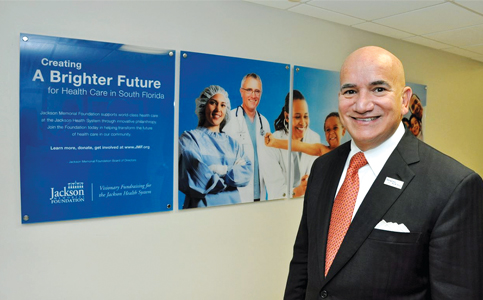
No deficiencies have been found in the suspended heart transplant program at Jackson Memorial Hospital, Jackson CEO Carlos Migoya told county commissioners last week.
While the program today has “great interim leaders,” he said, “we are getting really close in bringing two permanent leaders both in the heart transplant surgeon as well as a cardiology heart failure doctor.” He did not elaborate.
The heart transplant program has been suspended since mid-March among multiple investigations that have been widely reported. “What they didn’t cover is that both CMS (the federal Centers for Medicare and Medicaid Services) and ACA (Affordable Care Act) have found no deficiencies, which is kind of important to write,” Mr. Migoya said in an annual joint meeting of the Miami-Dade County Commission and the Public Health Trust, which oversees Jackson.
Defending the county hospital’s transplant program, Mr, Migoya said that “most people that have had a transplant, their choice, if they had not had a transplant, would be a negative one… this is a new opportunity for life for many people.”
“We are committed to all transplants,” Mr. Migoya said, “and frankly the way we look at it at Jackson, we provide transplants where many others don’t…. We are committed to every solid organ, and I believe in a year or two down the road, we will be just as proud of heart (transplants) as we are of lung (transplants) today.”Mr. Migoya noted that Jackson has tentative labor agreements with Jackson’s two largest unions, which drew praise from commissioners.
Commissioner Marleine Bastien noted that she had worked for 13 years at Jackson as a medical social worker and had been a proud union member during that period.
But the impact of the pandemic also markedly raised salaries as traveling nurses earned large amounts and the impact on health care and hospitals will be long term, noted Commissioner Raquel Regalado.
Commissioners, she said, must recognize that impact “this year and next year and possibly the year after that until something is done about the supply [of medical workers], and even when you look at the number of how many people are going into the field we know that it’s gong to be problematic for some time.”
Miami Today reported last September that hospitals nationally were in desperate need of registered nurses, with a quarter of those hospitals reporting at least 100 nurse position openings and most of them counting on new graduates and others looking to staffing agencies to fill their expanded nursing job openings.
“We are working more hours because we are very short of staff,” Armando Riera, a primary care nurse practitioner at Jackson, told Miami Today at that time. “What many nurses are doing right now is travel nursing, because they get paid more.”
One third of hospitals surveyed at the time said they were paying travel nurses over $150 an hour and another 25% said they were paying $125 to $150 an hour.
Higher costs and financial issues are nothing new to Jackson, which lost $95 million in 2011 and was down to less than 16 days of cash on hand, running on a hand-to-mouth basis.
“Jackson a dozen years ago was, to use health care terminology, in critical condition and on life support,” Public Health Trust Chairman Walter Richardson recalled at last week’s meeting. “The 180-degree of our community’s health system is nothing short of remarkable.”
Those at the meeting gave credit to Mr. Migoya for that turnabout. He came to Jackson with no health care experience in the spring of 2011 after spending 10 unpaid months balancing the cash-strapped City of Miami’s budget as its manager. His prior background was as a banker and an auto dealer.
When he took over, he looked for new ways to attract paying customers to a hospital that cares for all county residents regardless of ability to pay, and told Miami Today at the time that he aimed to attract more affluent patients.
One way to do that is transplant programs, but there were others. Mr. Migoya told commissioners last week that Jackson had many poor patients who didn’t know that they qualified to get Medicaid. Jackson got them enrolled.
“We provide this care for every Miami-Dade resident,” he told commissioners, “but we don’t have to provide this care for non-Miami-Dade residents.” People once flew in for that free care, Mr. Migoya related. “That doesn’t happen anymore.”
Meanwhile, Medicaid patients have been cut from 41% of all Jackson patients to the mid-30s, he said, and the hospitals are very close to being full.
“We have become more attractive to the paying customers… We used to be known as a hospital for poor people. We want to be known as a hospital for all people.” High-level specialties, he said, now are attracting more paying patients.



Recent Comments