


$450 million Miami public safety bond returning for action

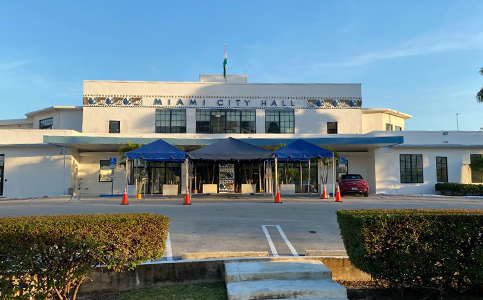
A $450 million bond proposal to rebuild Miami’s aging police, fire and public safety facilities was delayed again over concerns about total project costs, running up against a ticking clock to qualify for an August voter referendum.
The proposal was debated at length during the Miami commission’s May 14 meeting, its second appearance on the agenda since it was first introduced in April. The item would place a general obligation bond question on the Aug. 18 ballot authorizing up to $450 million for fire, police, 911 and emergency operations infrastructure, but commissioners ultimately deferred it for a second time and are now expected to revisit it May 28 after raising questions about financing assumptions, long-term cost projections and transparency.
The measure was introduced by Mayor Eileen Higgins on April 23, when commissioners were asked to place a general obligation bond question on the August ballot. If approved, the bond would finance four new fire stations, two major rebuilds and systemwide upgrades, along with a new centralized public safety facility intended to house police, fire, 911 operations and the city’s emergency operations center.
At the May 14 meeting, Ms. Higgins said the proposal stems from widespread facility failures she observed during visits to every fire station and the police headquarters, which she described as operating beyond safe capacity.
“There were months and months where there were no bathrooms on the first floor,” she said, citing flooding, electrical constraints, and water intrusion throughout the police headquarters. “These are not cosmetic problems. These are operational failures that are waiting to be a disaster.”
She explained that eight of Miami’s 17 fire stations are more than 50 years old and two exceed 60 years, adding that outdated designs have forced fire trucks to be stored outside in some locations and exposed firefighters to mold, exhaust and failing infrastructure.
Fire Chief Robert Hevia told commissioners the city’s response time gaps are directly tied to survival outcomes, citing medical research showing cardiac arrest survival decreases by 7% to 10% for every minute of delay. “If we arrive within eight minutes, you have two times the chance of survival,” Mr. Hevia said.
He presented city data showing neighborhoods where response times exceed six minutes, with some areas in the South Grove, Shenandoah, Flagami and Liberty Square regularly exceeding eight minutes. Mr. Hevia said Miami has built only four fire stations in the past 45 years, creating coverage gaps that force units to cross districts and, at times, leave other areas temporarily unprotected.
Under the bond proposal, $450 million would fund four new fire stations and two major rebuilds:
■A $13.2 million station in Allapattah.
■A $16.7 million station serving Shenandoah, The Roads and North Grove.
■A $14.56 million northwest Miami station.
■A $13.36 million Watson Island fire boat and station project.
Mr. Hevia also outlined plans to rebuild Fire Station 10 and Fire Station 1 in downtown Miami, both of which he said suffer from severe structural and mechanical failures. Station 10, built in 1964, cannot fit modern fire apparatus, with one truck currently stored outside due to space limitations. Station 1 still operates with outdated mechanical systems and exposes firefighters to exhaust and water intrusion, he said.
While commissioners agreed the infrastructure is in poor condition, several raised concerns about cost, transparency and timing. Ralph Rosado called for better maintenance budgeting and clearer public reporting on prior bond spending, noting that less than 2% of a previous bond had gone to police and fire infrastructure.
Damian Pardo urged the city to explore alternatives to general obligation debt, including developer obligations, special revenue bonds and possible proceeds from city-owned assets. Christine King supported delaying the vote, saying the city should not rush such a large financial decision. “No one up here is against having our fire stations and police headquarters addressed,” she said. “But I don’t think it’s fiscally responsible for us to act on it today.”
Commissioners also questioned whether an August election would draw enough voters to fairly reflect public opinion. Others raised concerns that the full cost of the projects could rise above $450 million once grants and other funding sources are factored in. They also pointed to the city’s downtown police headquarters site, estimated at $150 million to $200 million in value, questioning whether selling or redeveloping that property could offset bond costs.
The commission remained split over whether there was enough time to finalize details for an August ballot or whether the measure should be pushed to November to allow more review and public discussion.
The mayor urged moving forward, warning that further delay could worsen already unsafe conditions. Ultimately, commissioners agreed to defer the item to May 28, giving staff added time to review financing details, improve public-facing information tools and decide whether to proceed with an August or November ballot proposal.



Recent Comments