


Miami International Airport, PortMiami plan cutting-edge trade amenity

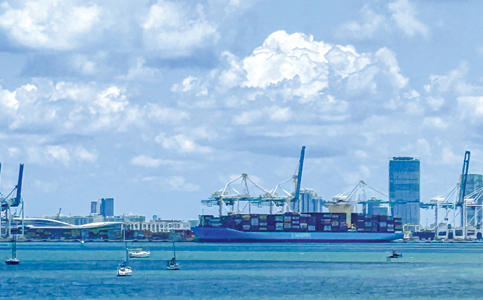
PortMiami and Miami International Airport are partnering to increase trade and products that arrive in the US through South Florida by creating a state-of-the-art facility to sanitize incoming goods and provide cold storage for them.
“We are expecting it to be highly innovative with technology and really be able to increase the products that come through here based on the functions that this facility will offer, really cutting edge and state of the art,” said Hydi Webb, PortMiami director and CEO.
The project, five years in the making already, will come via a partnership with a private developer who is yet to be chosen, Ms. Webb said.
In 2019, she explained, the port received a $33 million Port Infrastructure Development Program grant from the US Department of Transportation Maritime Administration for the facility championed by US Rep. Mario Diaz-Balart, who pushed it through Congress.
“The phytosanitary treatment and cold chain processing facility … is going to be located at the airport,” said Ms. Webb. “The way the grant was drafted, it has to be within a 10-mile radius from the seaport…. We’re doing this in partnership with MIA to increase the trade and the products that come through both of our facilities, so we will actively be using this facility together.”
The shared facility will be at 7449 NW 12th St.
“The cost in the grant application is $56 million of this actual project cost,” said Ms. Webb. “The federal funds that we’re receiving are $33.5 million, and our funds will be contributed to this project.”
The three sources of funds, she said, are the $33.5 million aid, $9 million from the seaport “and then the private company who is selected, they have a minimum to spend of $13.3 million and then anything above, whatever proposal they may be proposing.”
The seaport is strapped for land, said Ms. Webb. The goal is to have off-port fumigation nearby that can be shared by others to increase business.
Commodities most expected to be treated in these types of facilities, said Ms. Webb, are perishable such as fruits, vegetables and flowers. These perishables are being treated now; the goal is to increase the products that come in. “We want to be able to treat … meats and poultry and grains, perhaps medical equipment, and bring it all through, increasing our trade numbers.”
Two fumigation companies already work at the airport, said Christine Boldt, executive vice president at the Association of Floral Importers of Florida and member of the cargo stakeholders committee. “Because we have two fumigation companies already at the airport, they’re looking at trying to find an alternative to fumigation itself. What they’re currently looking at is irradiation, which doesn’t exist in South Florida right now.”
The current fumigation companies at the airport are TDR fumigation and AL-FLEX.
About two years ago, said Ms. Boldt, a third fumigation station at the airport shut down because there’s too little cargo to support three companies and the facility cost more to run than the way the two fumigation companies run now.
“The perishables industry couldn’t support the additional cost, and therefore it stopped doing business,” she said.
Some products are condition of entry, said Ms. Boldt. That means when those products come into the US, they must go to fumigation. However, most products like flowers, some fruits, vegetables and herbs only go to fumigation or have to be treated if a pest is found.
“The volume of stuff that goes to fumigation if a pest is found is very small,” said Ms. Boldt. “Those products are the ones that actually support the fumigation companies… The idea is, why do we want to put another fumigation station there? Let’s find something that’s an alternative to what’s there because the two fumigation companies, they can’t do irradiation … which is one of the ideas of putting it in that facility is irradiation, because that doesn’t exist in South Florida.”
The PortMiami media team said the facility will use one of the federally approved phytosanitary treatment methods, following US Department of Agriculture rules.
The US has only two irradiation facilities, neither in Florida, said Ms. Boldt. Having that opportunity could potentially bring in different products that are not coming into South Florida now.
“Irradiation is not something that can be used for everything,” said Ms. Boldt. “Currently, USDA does not have approval for irradiation for a lot of different products. It’s a specific list. If there is a potential for irradiation, then there’s an opportunity for different products to come in, or adding more products to the list that can be irradiated. The problem with having just an irradiation facility is USDA does not allow that treatment for every type of pest or disease.”
However, this doesn’t mean only irradiation will be done there; it’s hoped to do multiple things. The facility will also aid in cold storage.
“We’re just really excited about this project,” said Ms. Webb. “There’s a cold storage component to this as well in addition to the phytosanitary. The cold storage component assists with this so we can store, warehouse and move the goods more timely and sensitively through the whole process and more efficiently.”
In regard to flowers, said Ms. Boldt, more floral products are coming in by sea than before, “and part of that is the logistics in providing opportunities by air and sea coming into the United States from the countries of origin. If something does have to be fumigated – anything, not just for florals – it has to move from the seaport to the fumigation facilities that exist already at the airport.”
“Having a facility in between the airport and the seaport would provide an opportunity for that to be done,” Ms. Boldt said, “and then if, let’s say, the containers came from the seaport and moved to the new treatment facility, if it couldn’t move right away, at least there’s cold storage there that could potentially be used, and I think that’s the idea.”
Currently for florals, the only opportunity to take care of pests and diseases is through fumigation, said Ms. Boldt. Studies have indicated that irradiation could potentially extend the life of the flowers. However, it is very costly.
“To put stuff through in an irradiation facility would add cost to floral products, and it would add time because it’s not a speedy process,” Ms. Boldt said. “That would be the question of whether products could take on an additional opportunity to extend the life. But in the end, it would have to be passed on to the consumer, so is the consumer going to be willing to pay more for products that would last longer?”
The facility is expected to increase trade and create opportunities for South Florida.
“This is going to be sort of one of a kind, state-of-the-art facility,” said Ms. Webb. “Really, there’s not that many in the country right now that do both of these functions.”



Recent Comments