


36-story Miami River with 345 residences wins city OK
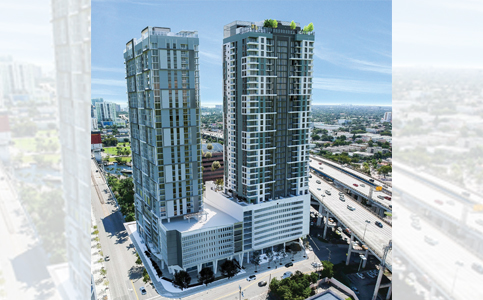
The evolving and expanding Nexus development on a bend in the Miami River downtown is ready with the next phase.
Owner-developer Lancelot Miami River LLC plans a new 36-story tower, home to 345 multi-family residential units, 393 parking spaces, a full suite of amenities including rooftop pool deck, and some ground level retail.
This phase of the overall project is called Nexus Riverside 1B, and will rise on property at 230 SW Third St.
The city’s Urban Development Review Board (UDRB) is recommending approval, with a few conditions.
This latest planned tower is part of a changing public-private partnership between the City of Miami and Miami-based developer Adler Group and Lancelot.
The original plan was to construct a new government office building for the city on property near the existing government building Miami Riverside Center (MRC), 444 SW Second Ave.
City commissioners and officials later chose another location to build the new government building.
Ryan D. Bailine, an attorney representing the developer, said the latest tower is planned for property on Southwest Third Street, directly north of and abutting the Miami Riverside Center.
The property fronts Southwest Third Street to the north, the Modera Riverside project to the east, the MRC site to the south, and an existing access road to the west.
Andrew James, principal at Nichols Architects, told the review board a bit of history about the high-profile site.
He said, “This is the second phase in series of projects, that was originally to include the City of Miami’s new office building. But during covid the plans were rethought and a new approach was taken for the office building.”
Adler Group decided to develop a multi-family apartment project at 230 SW Third St., he said, designed in concert with Phase 1A Nexus Riverside currently under construction.
“It’s a sister project,” said Mr. James, with civic space on a shared corner and streetscape plans.
In a letter about the newest phase Mr. Bailine wrote, “The property is located within a Transit Oriented Development (TOD) area as it is within less than a half a mile of multiple Metromover Stations, including Miami Riverwalk Station and Knight Center Station, and currently consists of vacant land.”
He said the property is a uniquely configured lot as it is impacted by several established utility easements. Specifically, FPL easements traverse the entire property along the northern frontage, at the northwest corner, and across the property, which precludes development upon those portions of the property at the ground level.
The developer is requesting waivers from the zoning code that if approved would allow:
■A reduction of the frontage setback above the eighth floor for lots having one dimension of 100 feet or less.
■Parking along a primary frontage, parking above the first story to extend into the second layer along the frontage, if an art, glass, or architectural treatment of a design approved by the planning director, with the recommendation of the UDRB, is provided for 100% of that portion of the façade.
■Up to a 30% reduction of required parking for a development within one-half mile of a transit-oriented development area (TOD) or one-quarter of a transit corridor.
■Up to a 10% reduction of required bicycle rack spaces for a development within a TOD area.
■Up to a 10% increase in the permitted building floorplate dimension for residential uses above the eighth floor.
Mr. Bailine wrote, “The property’s surrounding environment includes, amongst other elements, an I-95 overpass, an FPL power station, a draw bridge, and riverside architecture which mostly resembles utilitarian buildings.
“The project’s architectural style pulls and draws inspiration from the idea and elements of the river, without making the common references to nautical architecture. Instead, the project’s design uses slight angles and shifts in planes of the building envelope to create a ‘glimmering’ feel with different light reflection values while making large scale strokes with massing that recall the scale of the built environment of the overpass, power station and bridge structures,” he wrote.
He noted that the project will include an art mural on the south façade and the exposed portion of the east façade visible above the parking podium.
Board member Ligia Ines Labrada said having the two towers have a ground floor retail connection between lobbies will help reactivate that area.
“More life on the ground floor,” she said. “I think it’s a nice project.”
Board member Fidel Perez said, “I think you have a very challenging project on such a small piece of land.
“I was wondering why you didn’t utilize that open landscape area for your main entry. I think what you’ve done is separate the park-like piece of property … I guess you have to (do that) because of the easement, right?” said Mr. Perez.
A developer’s rep offered details of the several easements impacting the property, including an open area for undefined civic space.
“You’ve separated yourself from that. Why is that?” asked Mr. Perez.
Mr. James responded, “The main reason is, that corner is an FPL (Florida Power & Light) easement and it may get torn up and we didn’t want to have that facing the functioning entrance to the new building.”
Mr. Perez responded, “Well, you know what’s going to happen … it’s going to become a homeless shelter, due to the fact that you have no movement of people going through there.”
He continued, “I think the opportunity exists to utilize this piece of property, to create movement and eliminate later problems for yourself … I’m sure the landscaping will be good, but you need movement in that space.”
As for the large mural, Mr. Perez wants to see more of it. “I think you should take the mural all the way around the building,” he said.
Board member Anthony Tzamtzis said, “I think your drawing is deceptive, because you’re lacking some very important lines that you haven’t shown on the ground floor. You’re calling the corner a landscaped area … that area is more of a plaza. You’re missing the lines. It should be a hardscaped area.
“It troubles me that that whole corner is not very friendly, it doesn’t have any character,” said Mr. Tzamtzis.
Board Chairman Ignacio Permuy said, “I like a lot of things that are happening in the project, starting with the connectivity with the adjacent building.
“I like how you treated the glass and the height, it’s also very nice, and how you explained the dynamics of the ceiling, how it is going to play very well with the pedestrian circulation,” he said.
Other board members expressed a desire for more of the artwork.
“I also agree with my colleagues regarding the artwork. If there’s a way that you … I’m sure you’re going to do a great job, on two sides. If you could do three and possible give hints about turning some corners even … at least it brings everything together.
“It’s well articulated, the massing is pretty straightforward and I think you’ve done an exceptional job here,” Mr. Permuy said.
The motion to recommend approval had several conditions, including having the developer activate the green space and to wrap the mural around more of the building’s base.
The motion was approved unanimously.



Recent Comments