


Reef Line environmental art gets $5 million from city

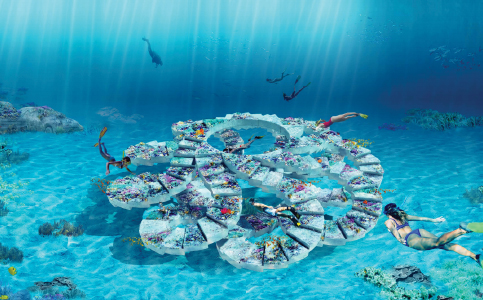
A large-scale environmental public art project expected to be built in upcoming years has scored millions from Miami Beach’s general obligation (G.O.) bond for arts and cultural facilities, which won majority approval votes in the Nov. 8 mid-term local election.
The $159 million in bond borrowing for arts and cultural facilities was approved with 64.8% of the votes, and The Reef Line, a 7-mile soon-to-be-built series of artistically designed artificial reefs along the Miami Beach ocean from South of Fifth to north of Fourth streets, has been approved to receive $5 million from the bonds.
The total cost of the project was estimated at $11.8 million, said Ximena Caminos, founder and artistic director of the Reef Line. Miami Beach Commissioner Ricky Arriola, she said, reached out to her and urged her to enter the project into the G.O. Bond funds allocation.
The underwater sculpture park vision started in the living room of her home, Ms. Caminos said, in conversations with Colin Foord, marine biologist and director of Coral Morphologic, a multimedia coral aquaculture studio.
“I became very interested in artists that were working with topics in relation to nature,” she said. “And one day, speaking with Colin about the nature of Miami and the works to preserve its beaches, he told me that very bad sand replenishment processes in 2002 smothered most of the reefs that were out there. The city recognized that area as somewhere where an artificial reef could be deployed. I had an epiphany.”
The Knight Foundation Arts Challenge Awards victory in 2019, with an $80,000 award she had to match, gave her the faith to believe in this project, she said.
“With those $160,000, I started a long road of understanding what we needed,” she said. “Getting permits, seeing if it was feasible, and speaking with scientists.”
Ms. Caminos met with Diego Lirman, marine biologist and professor at University of Miami who runs Rescue Reef, and with Shelby Thomas, who is now Reef Line’s science director, and Sylvia Earle, famed marine biologist, oceanographer and author. The purpose was to call for attention to the need for conservation of oceans and shorelines and the impact of climate change on those communities.
The project’s masterplan is composed of geometric concrete modular units designed by Shohei Shigematsu, partner at the Office of Metropolitan Architecture (OMA) based in New York. Some of the sculptures included in the Reef Line phase 1 include “Heart of Okeanos, a sculpture of the cardiovascular works of the Greek god of the ocean,” designed by British artist Petroc Sesti, according to the Reef Line website; Concrete Coral, designed by Leandro Erlich, a sculpture of 22 concrete cars under the sea; and Machine Hallucinations: Coral (an AI Data sculpture) from Refik Anadol Studio.
The G.O. Bond fund would cover 42% to 45% of the Reef Line project, said Ms. Caminos. “So, it’s a massive game-changer, because this is something that would have taken longer for us to do.” The project’s active permit allows for Phase 1 to start, which she estimates will take about a year and a half. After securing permits for Phase 2, “we can do everything we’re planning in three years and a half,” she said.
According to a press release, 87% of the $5 millions allocated to the Reef Line would go directly towards its infrastructure. “These funds support the Reef Line’s Phase 1 and 2,” she said in the press release, “and the use of scientifically informed and artistically designed artificial reefs, connecting the public to the ocean, educating locals and tourists of all ages and backgrounds on the importance of healthy marine habitats, coastlines and coral reefs.”
The Organization for Economic Cooperation and Development projects The Global Ocean Economy to reach $3 million by 2030. The US’s Blue Economy is estimated at $373 billion, according to the Middlebury Institute for International Studies. According to the Florida Ocean Alliance (FOA) 2020 Strategic Plan, Florida’s coastal counties generate more than $797 billion of economic value, making up to 77% of the state’s total economy. Direct and indirect use of ocean and coastal resources contribute $73.9 billion to Florida’s economy.
“Florida has essential, valuable, and iconic natural resources and human-built infrastructure along its 8,436 miles of coastline, the second longest coastline among US states and territories,” said the FOA’s 2020 Strategic Plan.
“The Reef Line can be among Florida’s next great Blue Economy attractions, bringing the triple-bottom-line benefits of ecological restoration, economic growth, and a higher quality of life,” said a July report by Civic commissioned by Ms. Caminos on the economic impact of the Reef Line. “The value of all of these impacts can be easily measured: ecological restoration leading to a more dynamic, diverse and stable ocean ecosystem; broad-based economic growth in the form of a unique and proven water attraction; and an overall quality life improvement for all parties, both tourist and local.”



Recent Comments