


County sidetracks opening of finished mental health center

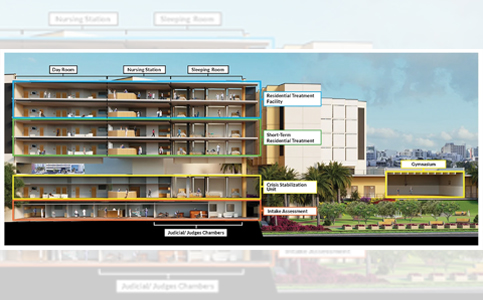
The Miami Center for Mental Health and Recovery, now sitting vacant awaiting its opening, has run into a roadblock as the county commission has sidetracked approval over concerns about sustainability of long-term funding, the center’s control and its operator.
The center, which is intended to treat appropriately mentally ill persons now caught up in jails and the justice system, has been in the works for years, and an unused building was converted for its use. The building is ready and certified for occupancy but remains vacant as disputes simmer.
The issue came to a head in a rare Miami-Dade County Committee of the Whole meeting in late August when Commissioner Keon Hardemon put his concerns on the table, asking that the commission act to open the center and take advantage of opioid settlement funds that would operate it for two years, saving the county $5 million a year that it pays to house mentally ill inmates.
As he outlined it, during those two years the University of Miami’s Department of Public Health Sciences would study the cost and economic savings of the mental health center, after which the county commission would review its long-term future.
In the audience as Mr. Hardemon spoke was retired Judge Steve Leifman, who has labored for 25 years to develop appropriate care for mentally ill inmates and has been the champion of the center for years. “It’s really magnificent,” Judge Leifman told Miami Today a year ago. “There’s literally nothing like it in the country, nothing even close.”
Mr. Hardemon last week sought speed to get the center open, to “move forward with an agreement that I believe is ready to go.”
Opening the center would save the county $5 million a year, Mr. Hardemon said, “because right now it costs us that money to keep this facility closed. This facility is ready to go … they’re basically ready to start operating.”
Florida, Mr. Hardemon continued, is now 43rd in the nation “for access to mental health care and it’s for the fourth highest rate of uninsurable mental health illness. We have a big mental health issue in the State of Florida, in particular Miami-Dade County, and how we go about treating people instead of putting them in jail.”
More than 75% of the jail population here has mental illnesses that account for 65% of bookings and 63% of all jail bed days in the county, he told commissioners.
“Apparently we’re not operating that facility right now because of an issue,” Mr. Hardemon said. “What’s the problem that we have?”
Commission Chairman Anthony Rodriguez responded that he has been holding the agreement for operation of the mental health center on his desk “because I’m truly worried with the deficit the county has and, you’re right, it’s costing us – I’m going to quote your number – $5 million a year.”
After the first two years of the center’s operation, Mr. Rodriguez said, “I think it’s $10 million [a year] from us. Yes, today it will cover for 24 months, but I’m worried about the future. I’m worried about years 3, 4 and 5, and even then it’s still safe because we’re kind of somewhat locked to, I think it’s $10 million … but then it worries me what happens after year 5…. It’s really just trying to be fiscally responsible for years to come.”
“Once we open the doors of this building,” Mr. Rodriguez said, “there’s no going back…. What are we going to do? Because we’re going to say ‘shut it down’? We can’t do it.”
The project was funded by $22.1 million in general obligation bonds as project 193 in the broad Building Better Communities General Obligation Bond program, approved by Miami-Dade voters in November 2004.
Construction began in 2019 on repurposing the original building, which had been the South Florida Evaluation and Treatment Center, a state facility used as a forensic hospital to treat and restore the mental competency of criminal defendants not able to stand trial. The building sat vacant and was leased to the county for $1 a year to be converted into the modern mental health center. Project costs exceed $50 million to date.
Mr. Rodriguez said the commission could discuss the future use of the building. “I’m not really opposed to the facility,” he said. “I think we’ve already spent the money on … renovating it…. So, I think we should absolutely do something with that building. I’ve had many conversations with the administration. They’ve been looking at what we can do per the bond and what the referendum was,” discussing “what is the most cost-effective way to use this building within the parameters of the bonding.”
“I want to see the item come to this board and we need to do it expeditiously,” Mr. Hardemon insisted.
But Mr. Rodriguez said he had received conflicting reports.
“The information that I was given by the administration just didn’t match up with what the judge said to me,” Mr. Rodriguez recounted. He said he was told that the bond debt had already been paid because it had been 20 years, but the administration said “the bonds had just started, because the bond doesn’t kick in until the construction ends.… That’s when the red flags went off in my brain. Okay, now I want to do a deep dive and start seeing what does this mean for the county.”
“It’s not easy,” said Commissioner Oliver Gilbert III. “We do need to open the building. The challenge is going to be that the administration and Judge Leifman really don’t agree on anything.”
Further, asked Mr. Gilbert, “who’s going to run the building? It’s more contentious than you would think helping people would be. At some point, who are the providers [and] staff, who’s going to be in charge? At some point it does have to come to a head, and it does have to come to the dais.”
Treatment of mentally ill persons is now left to jails and the sheriff’s office, Mr. Gilbert said. “That’s just stupid. It’s not going to make us money. We are going to have to in fact pay for it…. It’s probably time that we stop using our jail and our sheriff’s deputies as the primary therapists and clinicians for people who are mentally ill.”
“We also have to understand the cost of not doing something,” said Commissioner Micky Steinberg.
“We are not in a dispute with Judge Leifman,” said Mayor Daniella Levine Cava. “I wouldn’t want it to be out there that we were in a fight.” In fact, she said, she has put $3.2 million in her budget this year for the mental health center.
“The certificate of occupancy was issued a few months ago and we’re starting to shop for furniture,” Judge Leifman told Miami Today a year ago.
The Miami Center for Mental Health and Recovery’s facility has 181,000 square feet of floor space at 815 NW 57th Ave. It is to provide 208 beds on seven floors with services including intake and assessment; crisis stabilization; residential and outpatient treatment; primary, dentistry and optometry health care; transitional housing and housing placement; day activity programs, and job skill training.
The center is also to have onsite legal and social services and a courtroom.



Harold A Maio
September 3, 2025 at 10:10 am
Our attitudes and actions toward the illnesses we call “mental” fall far below our actions and attitudes toward the illnesses we call physical. As do our ethics.
Harold A Maio
Sam
September 3, 2025 at 7:37 pm
That building was renovated before it was handed over to the county. What the hell have they spent so much money on it asfter 20 yearaas vacant?
Absolute shame that this county is still run the way it is.
Tah samae thing happenning to the Miami Marine Stadium, let it deteriorate and then spend millions more for nothing!