


When a deal’s benefits are ‘sure to come,’ think of baseball

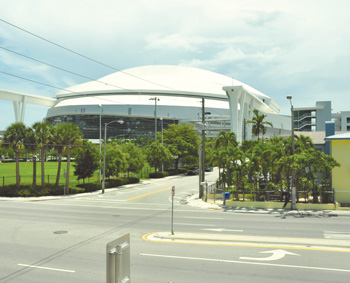
Once upon a time, long before anyone now in office got involved, top Miami-Dade and City of Miami officials created a massive project sold as an economic development deal that went terribly – and predictably – wrong.
Some of today’s officials label it the worst spending call ever.
It’s a lesson in irrational exuberance that officials should reference every time they plan to spend public money based on growth that’s “sure to come.”
The error was to believe promises of economic benefit that a baseball stadium for the Marlins would bring. That stadium was going to revitalize Little Havana while it gave the team a vast attendance bulge that would allow owners to hire and retain the best players and thus become a winner and a visitor attraction.
Those promises sold government on committing $3 billion – including balloon payments that have yet to be made – for promises that have yet to be kept. Look at the results.
An attendance need was the reason team owners gave for a new stadium that we then built for them.
In 2011, the last year playing in the Dolphins’ football stadium, the Marlins averaged just 19,007 attendance per game, which was the third worst among the 30 teams in the major leagues. Only Tampa and the Oakland Athletics, playing in smaller markets, were worse. But a new stadium was going to put all that in the rearview mirror.
What happened? As of this week, in 2025 the Marlins are averaging fewer than two-thirds as many fans as in the dark old days before they got a shiny new stadium. That’s right, the average is now 11,648 per game, third worst among the 30 teams, and better only than – you guessed it – Tampa and the Athletics.
But those two teams have valid excuses. A hurricane destroyed Tampa’s stadium last year and the Rays are now playing in a small low-level minor league stadium owned by a competitor, the New York Yankees, and are selling out almost every game. They can’t accommodate more fans.
Meanwhile, the Athletics are literally homeless, planning to move to Las Vegas where a stadium isn’t yet built. As a result, they are also playing in a far-off minor league park, this one in Sacramento, CA, where they have almost no fan base.
So why don’t the Marlins fill their stadium? A hint: it’s not because fans don’t want to see them.
In 2011, while the team was drawing just 19,007 viewers a game in Miami and was last in its division, the Marlins were averaging 30,834 fans when they played anywhere else but Miami. They had the second-highest out-of-town attendance in baseball, behind only the Yankees, who averaged 33,288 for a team based in baseball’s biggest market that is a historic winner.
What about today? In 2025, the Marlins are again last in their division and second-best in baseball in out-of-town attendance, averaging 33,328 fans a game – which is slightly above what the Yankees did in 2011. Only the champion Los Angeles Dodgers do better when away from home.
Marlins games are drawing almost three times as many fans out of town as at home. Everywhere the woeful Marlins play they are a hot commodity other than in the stadium that is costing taxpayers billions in their home town.
That $3 billion stadium bill hasn’t yet come home to roost.
Because Miami-Dade couldn’t afford to build the stadium that owners demanded as ransom to keep the team here rather than take it to Las Vegas (which now has the Athletics but no stadium) the county financed it via minimal payments for years on bond debt that will balloon to far more than $100 million a year for seven consecutive years starting in 2038.
If you’re keeping score, that bond money has done little good for anyone but the team’s former owners, who capitalized on the stadium’s economic value to sell the franchise at a major league profit, because the stadium lease has all the revenues from a county-owned facility coming to the team owners. Those revenues include ticket sales, sponsorships, advertising, non-baseball events in the county’s facility and more.
And because the county owns the building and land, the Marlins pay no taxes – all the benefits of ownership with none of the costs.
None of Miami-Dade’s expected benefits from a shiny new stadium ever came through. But, as we noted, none of the people who made a horrific deal for government is now in office, nor is anyone who will have to suffer with the billions of dollars that government still owes on the deal when those balloon payments expand in 13 years.
It’s easy to go shopping for big government deals when your successors will pay later. Besides, as in baseball, those deal benefits are “sure to come.”



Shameful
June 11, 2025 at 10:17 am
$3 Billion or more. Yes, including debt service the taxpayers of the City of Miami and Miami-Dade County are forced by elected officials lead by ex-Mayor Manny Diaz and recalled ex-Mayor Carlos Alvarez to divert over $3 Billion to the Marlins Stadium and Garages. And the taxpayers were forced to give up a 40 acre public park to this scam. The former owner of the Marlins left Miami and returned to Canada with over $1.5 Billion of the taxpayers money. Shameful.
Taxpayers Screwed
June 14, 2025 at 9:37 am
Elected officials stole over $3 Billion from taxpayers as they pandered to a sleazy scammer from Canada. Idiot and/or corrupt commissioners stole money for the Marlins Stadium.