


State to pay for the first four of 56 Miami trolley replacements

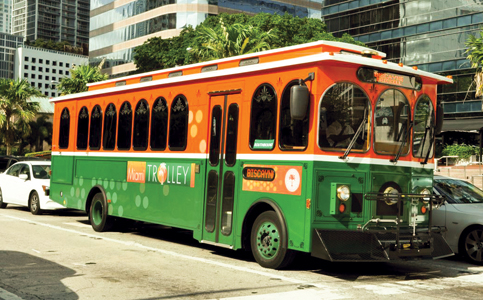
As Miami gears up to roll out a revamped trolley fleet by 2035, the state’s transportation agency is contributing $1.8 million to help purchase new vehicles.
Today (5/23), the city commission is poised to approve a public transportation grant agreement with the Florida Department of Transportation and accept the $1,841,311. The monies will replace four aging trolleys in Miami’s 56-vehicle fleet, which the city plans to completely refit over the next decade for a projected cost of $56 million.
Florida is home to four of the nation’s top five fastest-growing metropolitan areas with Miami ranking fourth, according to a March news report from the US Census Bureau. With the continued population growth, Miami increasingly needs more efficient public transportation options.
“In an effort to reduce vehicular congestion, improve pedestrian mobility and enhance transit service within the City of Miami, the city wishes to replace transit vehicles in [its] trolley program,” reads the commission resolution to approve the grant.
In April, the Transportation Planning Council met to discuss the city’s Trolley Efficiency Plan Study and review recommendations for replacing the fleet. The council advises the Miami-Dade County Transportation Planning Organization on proposed programs and actions.
The efficiency plan includes a fleet condition overview, an alternative fuel technology assessment, a fleet replacement plan, facility and infrastructure requirements as well as potential grant sources.
It compares alternative fuel technologies including battery electric buses and fuel cell electric buses. Battery electric buses convert electricity from batteries to power the motor through propulsion while fuel cell electric buses operate through both a hydrogen fuel cell range extender and onboard batteries.
The plan recommends using battery electric buses since the equipment has been road tested and the heavy-duty buses have operated nationwide for over a decade. Additionally, multiple fleet manufacturers allow for more competitive pricing than other fuel technologies and the necessary charging equipment is widely available and less expensive than that needed for fuel cell electric buses, the plan says.
Cost estimate comparisons show battery electric buses priced between $920,000 and $1.4 million apiece whereas fuel cell electric buses range from $1.1 million to $1.5 million.
The city’s current fleet of 56 trolleys average an annual mileage of about 25,971. Of the 56 trolleys, 14 are from 2012, 17 are from 2013, 10 are from 2017, 12 are from 2020 and three are from 2022.
The project description in the city’s grant agreement with the state says the four trolleys the funding will help replace are from 2013, 2014, 2015 and 2019.
The efficiency plan also presents two scenarios premised on achieving fleet conversion by 2035. Scenario one includes retrofitting the existing facility at 3737 NW 43rd St. and scenario two involves the development of a new site.
Scenario one evolves in three phases, with 10 trolleys replaced and two maintenance bays retrofitted by 2028, another 15 trolleys and three bays by 2031 and the last 31 by 2035.
Scenario two features a new site and is also divided into three phases. The first includes the site selection and acquisition and replacing 10 trolleys by 2026. This scenario also guarantees total fleet replacement and a new facility by 2035.



Recent Comments