


Will Miami Wilds water park be blindsided by a bat?

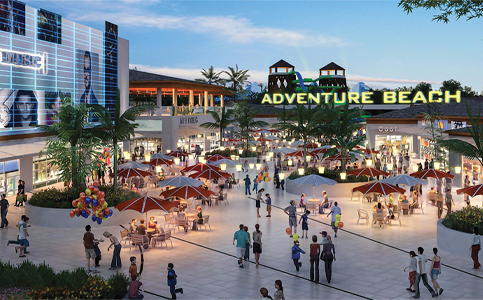
The longest-running drama in Miami-Dade is not the battle to revive the closed Coconut Grove Playhouse, now dark for its 17th year, but the bid to create a water park beside Zoo Miami, now in its 26th futile year. Neither shows signs of a happy ending for everyone.
While playhouse action now is backstage, however, the Miami Wilds water park plan is to return to the spotlight before county commissioners next week. Whatever twists and turns that session may take, history suggests that the drama will go on.
This script has no villains, only heroes whose aims have conflicted with one another. Let’s look back at how what seemed to be a viable concept stalled.
Think of the area where the water park is targeted, beside Zoo Miami in south Miami-Dade County, and the area’s status a quarter century ago. Also note that while the project is now in the hands of a sometimes-vilified group – developers – it was born not in corporate offices but in county hall.
In 1992, Hurricane Andrew devastated South Dade, causing $30 billion in damage, leaving 250,000 homeless and damaging or destroying 82,000 businesses. Areas near the zoo took a thrashing in the hurricane, and five years later the economy still lagged far behind its past, and far behind the rest of the county.
A young commissioner representing that area, Dennis Moss, had an idea, a concept he pursued relentlessly to create a water attraction beside the zoo to lure tourists from around the nation either enroute to the Florida Keys or swinging south after visiting Walt Disney World.
“You have to go from a vision to implementation,” he said, “to create destinations to bring people in so they’ll spend money. That’s what the long-term aim is.”
Mr. Moss pushed the idea beginning in 1997 and finally, in 2006, got a referendum in which voters approved the concept. As it happened, 2006 was also the last year the Coconut Grove Playhouse raised its curtain. Neither venue has completed the journey to a new day.
By April 2008, led by Mr. Moss, the county commission was set to push forward with a $40 million water theme park and family entertainment center on a zoo parking lot. “This builds an additional economic engine in the community,” he said then. “This is something I’ve been working on for a long time.”
Mr. Moss, who last year hit his term limit, retired from the commission with a final vote on his dream yet to come.
As he and other commissioners planned in 2008, the county would get either separate or joint attractions on a 43-acre parking lot with rides and slide towers, a wave/surf pool, family raft rides, a water coaster and an interactive play area.
One aim was to get 500,000 water park guests yearly and in the process drive zoo attendance higher than its then-current 600,000 level. The zoo passed 1 million for the first time in 2021 without the aid of a water park.
With the expectation that an attraction could open by 2011, commissioners in 2008 unanimously approved land-use changes for the zoo land to clear the way to seek developers.
“We had to get past this,” Mr. Moss said at the time. “We couldn’t move forward with an RFP (request for proposals) until our land-use issues were resolved.”
Commissioners were ecstatic. “Parks like this one deter crime in the community,” said Rebeca Sosa. Joked Katy Sorenson, “Disney World will be nothing compared to Dennis (Moss) World.”
The request for proposals got two would-be developers in 2009 – the first in a line to follow of potential developers and operators. The wheels of government grind slowly.
With prescience, the county parks department’s contract administrator, Jon Seaman, said then, “There’s no timeline. It’s moving as fast as the process would allow.” That remains, unfortunately, true today.
The lease with the county dragged on and on – it was finally approved in 2022. Meanwhile, the cast of players to operate the complex kept changing. The second wave included 20th Century Fox and a company proposing a dinosaur-themed museum.
Finally, in 2013 the present group of partners to design and lead the complex took over under the name Miami Wilds LLC. It is that group due before the county next week for the next step.
“We always anticipated the Miami Wilds project would be developed in two phases, with phase 2 following immediately behind phase 1,” Paul Lambert, Miami Wilds project director, said in 2015.
“What was unanticipated, I think we can safely say by nearly everyone in our group and county government, was that US Fish & Wildlife would require such an extended habitat survey and approval process associated with the phase 2 site even though the Miami Wilds plan does not call for developing any of the Pine Rocklands forest.”
Up to the present day, however, the concerns for plants and animals associated with the Pine Rocklands has been a major sticking point holding back Miami Wilds. Rather than earlier focus on Fox or dinosaurs, the fate of the Miami Wilds plan is caught up in the future of the Big Pine Key ringneck snake, the Miami tiger beetle and the bonneted bat as four conservation groups have pushed legal efforts to deter the Miami Wilds plan.
“Putting that theme park next to the pristine wildlife has spillover effects,” said Matthew Schwartz, executive director of the non-profit South Florida Wildlands Association. “You have noise, lighting, pollution.”
Those battles over conflicting aims for the land continue, with a new May designation of 1,800 South Florida acres by the Fish & Wildlife Service as protected critical habitat for some species, including some land earmarked for Miami Wilds. The National Park Service and the county are now working together to protect those endangered species.
As the conflict goes on over competitive needs – community economic growth versus conservation – the timeline for a water park pushes further and further into the distance, pieces of land have been pushed out of the plan, and the estimated cost has been pushed up from the initial $40 million to now $105 million.
Given shifting starting and completion dates over the years, the statement by Jon Seaman that “There’s no timeline” remains the only totally clear fact about Miami Wilds.
The big dilemma is not when Miami Wilds can open or how much it will finally cost but whether the South Dade economic engine that Dennis Moss envisioned 26 years ago can ever be compatible with area environmental aims. Will Miami Wilds, in the end, be blindsided by a bat?
The county commission takes the stage next in this long-running soap opera. Stay tuned.



DC
August 30, 2023 at 8:19 am
It’s a terrible idea. Instead of “growth” the county should be focusing on “preservation.” What, you can’t make money on tourists wanting to see wilderness? I hope it finally dies on the dais this time around.
Richard R-P
August 30, 2023 at 12:37 pm
Couldn’t agree more. Put the nail in the coffin already.
APM
September 2, 2023 at 4:51 pm
We need to protect the environment. The land and the animals that live on the Rockland are federally protected. Enough is enough!
Kim
September 6, 2023 at 8:21 pm
Best article I’ve seen on this yet!! Thanks for the history lesson, I learned a lot. It’s crazy that they are still trying to go forward on this so close to the pine rocklands. I get that they might not have known how important that land is when developing the idea (it’s easy to miss the importance of something when you’re so close to it) but with what we know now it would be insane. The pine rocklands animals you mentioned are white-rino level endangered and some are only found in that tract. Crazy to think that a water park right on the edge of the forest wouldn’t effect anything, or that destroying the foraging area of the bonneted bat is something to scoff at.