


PortMiami Tunnel blazes trail to future
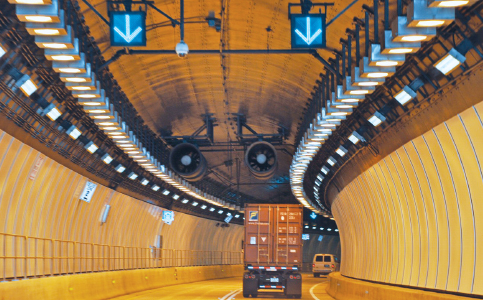
Some 120 feet below sea level the 42-foot-diameter PortMiami tunnel connects the mainland to Miami-Dade County’s second-greatest economic engine, supporting more than 334,000 jobs and contributing $42 billion annually.
Since opening to traffic in 2014 after over four years in construction, it has become a gold standard for tunnels in Florida and in the nation both during construction and now during operations and maintenance.
Now, as local governments are looking at adding other tunnels to increase mobility, the port tunnel’s track record offers guidance for what more tunnels might achieve.
Only a year after opening the $1 billion tunnel – including $668.5 million for design and construction by Miami Access Tunnel Concessionaire LLC in partnership with the Florida Department of Transportation (FDOT), Miami-Dade County, and the City of Miami – the department won the Grand Prize for the Port Miami Tunnel in the 2015 America’s Transportation Awards national competition.
When the tunnel was being built, the company created the local hire program Operation 305, employing 7,000 people, 83% from Miami-Dade. “In addition, we looked at diversity; we matched the diversity in the community,” said Christopher Hodgkins, CEO of the Miami Access Tunnel Concessionaire, which built the tunnel.
“We were 51% Hispanic, 28% Black, and 11% Anglo. We had women in management positions and as superintendents of construction, so we really did a phenomenal outreach campaign to make sure that we were a mirror of the community,” he added.
The project was a pioneering public-private partnership (P3) in the state. It was completed on schedule and $90 million under budget, Mr. Hodgkins said. To date, the tunnel has taken out of downtown Miami 80% of the trucks that in the past had to go through the city’s core to get to the port. Traffic inside the tunnel has increased about 265%, Mr. Hodgkins said.
As Miami Today previously reported, PortMiami cargo has been growing after Covid-19 slowdowns and is expecting a conservative growth of 3% year-over-year. Last year, the port recorded a cargo performance high of 1,254,062 TEUs (20-foot equivalent units, a standard measure of cargo), accounting for an increase of 17.56%, or 187,324 TEUs, over fiscal 2020.
To run operations safely, the tunnel has infrared, vibration and air quality sensors,105 roadway CCTV, 40 hose valve cabinets, 44 jet fans, 22 incident management plans, and it was built considering Miami’s sea level rise. The tunnel has 55-ton metal gates to prevent water intrusion once a hurricane is approaching the area and authorities issue flooding warnings.
In the event of an incident inside the tunnel, operators must clear the area within 24 minutes, Mr. Hodgkins explained. If they take at least one minute more, they get heavy fines. “We’re paid to keep the tunnel open, and when it’s not open we don’t get paid, and the fines are dramatic,” he said.
As a result, the company keeps a heavy tow truck and a flatbed tow truck so it can act quickly. “Miami is also the exotic car capital of the world, so you can’t just tow a Ferrari or a Lamborghini, you have to have a special type of flatbed to do that,” Mr. Hodgkins said.
The tunnel only closes four to five times a month for routine maintenance, at night when traffic is low to minimize disruption to seaport operations. Staff does everything from cleaning the walls and checking the lights and fire extinguishers to calibrating the sensors.
Wendy Conforme, tunnel chief operations officer, said they have a five-year program with an average of $1 million per year for capital repairs. These include completion of a three-phase project to install LED lights, installing new stripes in the tunnel to reflect car lights, investments in the technology used to monitor the activities inside the tunnel, and improvements to the buildings and some driveways in the vicinity.
Miami Access Tunnel Concessionaire is paid $42 million a year on a monthly basis for operations and maintenance. The company makes money from its financing of the project, which is done through a teachers’ pension fund. “It’s not a sexy investment. It’s just a stable investment,” Mr. Hodgkins said.
Once the tunnel hits its 30-year anniversary, it’s to be returned to the Florida Department of Transportation in pristine condition. “At the end of the 30 years, we’re supposed to give back these assets to FDOT with a minimum life remaining on these items, so it’s pretty much like new,” said Ms. Conforme.
The City of Miami and Miami-Dade County have been interested in bringing more tunnels to the area to help alleviate traffic. For instance, the Transportation Planning Organization, responsible for the transit priorities of the county and federal funds coming, completed a study in February analyzing emerging tunneling technologies.
The study identified potential corridors for boring tunnels as Miami Central to PortMiami, FTX Arena to the Design District, Miami Central to the Design District, Overtown Connector, Magic City Casino to Douglas Road, and the Ludlam Corridor.
The document analyzed tunnels from 14- to 57-foot diameters and found costs would range from $30 million per mile for smaller diameter tunnels to over $100 million per mile for projects that are of larger diameter.
Miami Mayor Francis Suarez informally discussed with Elon Musk boring a tunnel under the Brickell Avenue Bridge in early 2021. Mr. Musk’s pitch to the mayor was that he could build a roughly two-mile tunnel for around $30 million in six months, according to reports from the Miami Herald.
The Boring Company, owned by Mr. Musk, has already completed the 1.5-mile-long and 13.5-foot outer diameter and 12-foot inner diameter Las Vegas Convention Center Loop.
“We’re excited about government talking about tunnels because they work. We know they work because they took 80% of the trucks out of downtown and dramatically reduced the carbon footprint,” Mr. Hodgkins said. “But tunnels have to be really designed as a transportation alternative. It can’t be a vanity project; it’s got to be something that’s designed based on international safety standards.”
“Everything that we’ve seen about some of these alternative tunnels, as we call them, don’t meet engineering standards. They will not meet federal standards. They will not meet Florida Department of Transportation standards. So, they will have to be funded by the people building them themselves, as they did in Las Vegas and in LA,” he added.
Ms. Conforme said there are many factors to consider when building a tunnel, such as the diameter. “A tunnel is a confined space, it’s not a roadway.
A lot of people want to think that it’s a roadway [but] it’s not. It’s a bunch of systems, mechanical, electrical, fire, life safety systems, and the main point of the tunnels to have these systems is to keep you safe as you are going through them. Safety is our number-one priority, and a 14-foot diameter tunnel doesn’t provide for any of that.”
Geology is another element to look at. “We were not going through locations with a lot of buildings, or tall buildings like we have in downtown, so that would be a consideration,” Ms. Conforme said. “We were going through Watson [Island], and we had probably one- or two-story buildings over at the port that we had to be concerned about, but everything changes just a few feet away in downtown with all of those tall buildings and people living in those areas.”
As far as costs, Mr. Hodgkins warned that “when anybody tells you they can do it for one-tenth the cost, we live in South Florida. We’ve seen that a lot, right?”



Stanley Kramer
August 3, 2022 at 11:09 am
Suggest the story should note the successful partnership with USDOT and the TIFIA infrastructure finance program in financing the Port of Miami Tunnel. The $341 million secured loan with USDOT was an important factor in getting this critical project financed.
William
August 3, 2022 at 6:27 pm
That miami port tunnel project had a 150MM oops change order for grouting the sea bed above the tunnel. It was a disaster as far as public project finances go. Hopefully this lesson can be learned on future projects.