


Downtown Development Authority spent $100,000 for outdoor dining

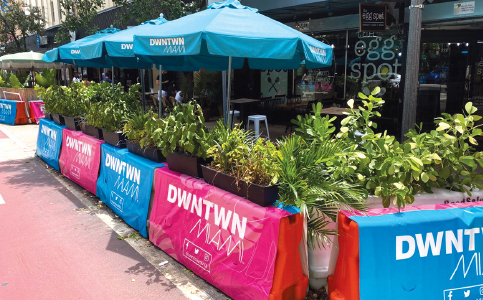
The Downtown Development Authority has spent over $100,000 on barricades, bistro tables and umbrellas to keep restaurants in business during the pandemic, and some want to continue on.
“In an effort to help Miami restaurants get up and running following the Covid-19 shutdown, the Miami DDA has been collaborating with the City of Miami to implement the Restaurant Recovery Program,” said Neal Schafers, DDA head of urban planning, resilience & transportation. “The program allows restaurants to temporarily add or expand outdoor seating in Miami Parking Authority on-street parking spaces while safely meeting social distancing requirements.”
The temporary program that has allowed 28 downtown restaurants to place 119 barricades, 80 umbrellas and 66 bistro tables purchased by the DDA, all in protected parking spaces, expired Dec. 31. On Nov. 18, 2021, a city commission resolution made the program permanent.
“While the City of Miami’s Department of Resilience and Public Works is currently implementing the program, it has not been finalized yet,” said Mr. Schafers. The Restaurant Recovery Program is active in downtown Miami, Wynwood and Coconut Grove.
The resolution makes it clear that sidewalks are primarily for pedestrians. Street cafés must leave five feet of width on sidewalks. Restaurants must show a drawing of the outdoor layout.
The city resolution also highlights the role of on-street parking to provide access to destinations along a street, aid in speed reductions and provide a buffer between the sidewalk edge and moving traffic. Public right-of-way access must be maintained, it says.
Downtown restaurants can apply for a permit for outdoor seating on public sidewalks, nearby on-street parking spaces, roads or traffic lanes closed by the city, private walkways and parking and driving areas.
The permit is granted by the city to operate a street or sidewalk café and is valid up to one year. Permits are required from the director of the Department of Resilience and Public Works. An application fee of $175 and inspection fee of $10 go to the director of finance and the Department of Off-Street Parking. The annual fee for a sidewalk café permit is $11.50 per square foot of right-of-way area.
In addition to the application fee, the Department of Off-Street Parking sets an annual permit fee for maintaining a street café. The city commission can waive or reduce any fees.
“The City of Miami’s Department of Resilience and Public Works is currently implementing the program,” Mr. Schafers said. “Once the permanent program is released to the public, individual restaurants should have a clearer understanding of what it will cost to continue to utilize either sidewalk cafés and/or on street parking spaces.”
The total costs per location will be application, inspection, survey, permit, barricades and annual fees to the Miami Parking Authority.
The 119 water-filled barricades donated by Moriarty Construction and rented by the DDA from Roadsafe have been called an “eyesore.”
“The City of Miami Public Works defers to either Florida Department of Transportation standards or Miami-Dade County Department of Traffic and Public Works standards, and they both approve only Association of State Highway Transportation Officials’ approved devices,” Mr. Schafers said. “We would hope that the city or county would allow other devices, including large and heavy landscape planters.”
Forty-two restaurants within DDA boundaries applied for a Miami Restaurant Recovery permit, 37 were approved and 28 got the barricades.
“People generally just enjoy eating outdoors.” Mr. Schafers said. “Here in Miami, when it’s not too hot, humid or rainy, the outdoor dining spots are excellent, particularly in the months of December through April. Also, many of the restaurants in the Central Business District inhabit much smaller storefronts, so they have very limited indoor seating. I see the outdoor dining spots full for breakfast, brunch and lunch, and even on weekends.”
The Egg Spot at 228 SE First St. has benefited from the outdoor seating. “It’s fantastic for us,” said manager James Diaz. “It has increased 20% capacity. It is a goal to have outdoor seating permanently.”
“The outdoor dining has truly transformed often-deserted streets of downtown into a more vibrant and welcoming environment,” Mr. Schafers said. “The Restaurant Recovery Program greatly expanded their dining footprint.”



Recent Comments