


Miami should protect its Melreese asset, not kick it away

City commissioners can make a heroic choice to benefit residents by repelling a lease that would turn Miami’s only golf course into a developers’ playground beside Miami International Airport.
Just two commissioners can prevent permanent loss of the city’s largest green space – Miami’s equivalent of Central park – to a multi-use complex larger than Brickell City Centre plus a soccer stadium. The 99-year no-bid lease requires four of the five commission votes.
Mayor Francis Suarez – who has led the charge to kick the prize 131-acre city holding over to a consortium led by brothers Jorge and Jose Mas and Inter Miami soccer team front man David Beckham – has called a Feb. 23 commission meeting on the lease.
The mayor can count to the four votes he and the developers need, and Commissioner Manolo Reyes has steadfastly opposed loss of parkland without a larger contiguous park site in return, which is nearly impossible to find.
That requires one more vote to scuttle a giveaway the city never sought. Area commissioner Alex Diaz de la Portilla and Joe Carollo have focused on getting, as Mr. Diaz de la Portilla said, “a really, really good deal” for Melreese. But no matter how good, the parkland would be gone. We shouldn’t trade greenspace for greenbacks.
Commissioner Ken Russell, meanwhile, is looking toward an elected goal: the US senate. Does he plan to campaign on what a good deal he got for our Central Park or on how he saved it?
The other voter, new Chairwoman Christine King, has not gone public on Melreese. She can make her first big mark by protecting Miami’s greenery.
There was never a city effort to lease or sell Melreese, which despite a country club title in its long formal name is actually a public golf course that has welcomed every economic level and ethnic group at an reasonable price.
This has been a course where everyone could show up and play, no membership required, a true municipal amenity. A player might be grouped with whoever is there. Decades ago I was casually joined in a game by, among others, an older resident, Mrs. Mel Reese, widow of the city manager for whom the course was named.
Imagine the largest city in Florida – Florida, of all places – without a golf course. Golf has a limited public, but so do our performing arts venues, and who would dream of having to say that the performing arts can henceforth be found elsewhere in the county but not Miami?
The developers’ plan itself is fine other than the site they aim to pry from residents. We have nothing in principle against massive office complexes or hotels or vast shopping centers – the pandemic trend has been to shop much more online and much less in malls, but that is a developers’ business decision more than a public policy issue. Certainly, we’d cheer for Inter Miami having its own soccer stadium.
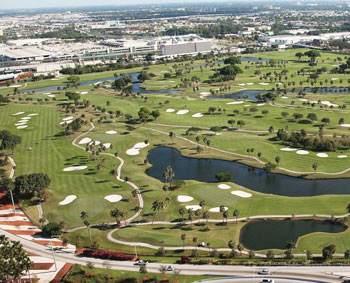
Miami commissioners are to determine future of city-owned 131-acre golf course.
But the location is all wrong.
Prize public land never went out to bid; the city is negotiating how much it can get for land it never wanted to lose. Nobody else got a chance to play.
It’s also, as noted, open space in a cosmopolitan city. They aren’t making any more of that. When it’s gone, it’s gone forever.
Unmentioned but vital, the site is adjacent to Miami-Dade’s undisputed economic engine, Miami International Airport, which is our lifeline.
The previous aviation director noted in early plans for what is branded Miami Freedom Park that four of the eight initial buildings were taller than the Federal Aviation Administration’s maximum and would limit where planes could take off and land, and how much load they could lift into and out of Miami. That alone should ring alarms.
Now the airport’s new administration is caught in a cargo crunch: a leading international airport is running out of cargo capacity and is scrambling for solutions as cargo demand soars. Imagine the added burden of planes having to lighten loads to safely clear buildings on what is now a nice flat golf course.
Frightening as dangers are to the airport, city commissioners don’t fret about it, because years ago the city handed the airport to the county in another giveaway of its assets (PortMiami was another gift to the county). It takes a thoughtful commissioner to realize that while the city has no responsibility for the airport, the airport’s activities control paychecks of a large percentage of residents – and, indirectly, the city’s tax income.
Certainly some commissioners will vote to hand over Melreese on the pretext that the city will get a good monetary return. Of course, we could get a good return by handing over our bayfront city hall or other municipal assets, and if the aim was only to maximize money coming in that might be praiseworthy.
But good return on assets sold off one by one is no way to run a community. We elect commissioners not just to serve residents today but to safeguard assets for tomorrow. This deal fails that test.
Some commissioners, like the developers, may also cite the fiction that in voting for a lease they’re doing what voters ordered, because in a 2018 referendum 60% of voters agreed to allow commissioners to negotiate. Developers claim that vote was a mandate. But it’s too long a stretch of meaning to claim that permission to discuss a deal is a mandate to sign it.
Commissioners who plan to vote for the lease will say the current plan is “all” the site will hold. But plans for a billion-dollar development are to be the minimum that will rise, not the maximum. Commissioners must be upfront that over the years developers can keep on building on the public’s land. There is no ceiling.
If all of that doesn’t add up to a vote against this deal, it seems clear that Melreese’s residential neighbors don’t want major development there, immediately adjacent to their neighborhood park.
After years of negotiations, rejections of a lease would no doubt be a blow to developers. But the city never asked them to the table; it was the developers who brought the city. You can’t win them all – ask Inter Miami.
In this case, it’s the residents who deserve the victory – a heroic gift that their commissioners alone can and should give them.



Anonymous
February 2, 2022 at 9:59 am
Fun Fact: According to the Herald, “MasTec, was among the biggest contributors in Miami’s elections last year, giving $97,000 to Carollo’s campaign and $10,000 to a political committee supporting King. In October, a committee tied to Díaz de la Portilla, who was not up for reelection, received $50,000 from MasTec. A Suarez political committee received $25,000 from the company in 2017.” So that’s 3 commissioners benefiting from MasTec’s political contributions in addition to the mayor. I wonder how they’ll vote.
M. Smith
February 21, 2022 at 8:37 am
If Miami’s Suarez administration hands Melreese
park to MasTec, M-D County Mayor should demand a right-of-way for commuter rail from MIA-MIC
Airport Station ,thru the park and over Lejeune Road, to connect with EXTISTING TRACKS to Homestead / Florida City. The County needs to be a part of a regional commuter rail system.