


Send Miami air cargo capacity soaring as fast as demand


Miami-Dade keeps building its case to add to cargo capacity quickly at Miami International Airport. It’s a good case.
First, the airport is nearing the limit of its ability to handle cargo.
Capacity is 2.6 million to 3 million tons a year, a report the mayor sent to commissioners this month says. The report estimates cargo this year at 2.6 million to 2.7 million tons, up from 2.3 million in 2020 and 2 million in 2011, with average annual growth of 1.62%. Demand above capacity is not just on the radar, it’s almost landing here.
Second, air cargo is not “a” slice of the economic pie. It’s key to “the” economic engine of Miami, which is Miami International Airport.
While the airport’s hallmark is passenger flow, most passenger planes carry cargo too, which is a fifth of all cargo coming through Miami International and vital to passenger airlines’ revenue. If we choke off that revenue because we can’t handle all the cargo, it might impede passenger business.
Third, more than four-fifths of air cargo in Miami is vital international trade.
Miami’s air freight began in the 1930s with Pan American World Airways cargo between Miami and Havana. Today, 43 cargo-only airlines land here, mostly hauling freight to and from Latin America. Miami’s robust corps of 1,500 freight forwarders, integrators and logistics operators, plus cooler infrastructure for international trade and international banks, trade offices, consulates and others, depend on Miami’s international air cargo.
Fourth, we have no monopoly: what we can’t handle well will go to competitors.
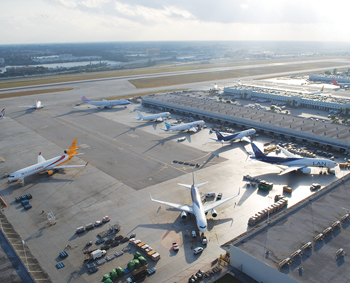
Miami International Airport is nearing the limits of its ability to handle growth in cargo.
In 2020, Miami International handled an astounding 85% of all air imports and 80% of all air exports between the US and Latin America and the Caribbean, the county report says. Our competitors for international freight are gateway airports Los Angeles International, Chicago’s O’Hare and John F. Kennedy International. Regional competitors Dallas Fort Worth and Atlanta “have been very aggressive in recent years with air service and marketing efforts in an effort to penetrate the Latin American market, particularly with perishables product,” at which Miami now excels, the county report says.
In November, after hearing a county committee lament inadequate air freight capacity, Miami Today asked the administration to quickly unveil its ongoing discussions on expanding capacity. Within a week, the Aviation Department told us of an outside offer to create a vast five-level cargo hub at the airport. The mayor this week is asking permission to negotiate that offer.
The concept, the report to commissioners says, would be like “the two state-of-the-art vertical multi-level facilities at Hong Kong International Airport (the largest cargo airport in the world).”
Whatever the county decides on that offer, it’s clear that some other avenues to Miami cargo expansion have little to no chance.
The report concludes that the county’s four smaller airports can’t help ease the cargo crunch.
As for enlarging Miami International on land to the west, that depends on owners marketing lands there. The airport bought one site recently, as Miami Today reported, but assembling more depends on owners selling affordably as the value of industrial land near the airport soars.
The county would be foolish to reduce space for passenger traffic to add area for cargo handling unless it found a way to go vertical for terminals, aircraft storage or other uses of its land. Such solutions might be real someday, but not soon enough to resolve a cargo crunch. The vertical cargo offering could be ready in four years.
Covid’s impacts make it hard to gauge change based on year-over-year statistics, though in the 12 months ended Oct. 31 just a hair under 18% more freight flowed through Miami than in the 12 prior months. That double-digit growth won’t be the norm, but the airport’s freight growth has been winging strongly upward, a trajectory we should sustain.
As the county reviews the offer of a vertical cargo system, officials should be looking to add freight capacity quickly minus typical requests of “what’s in it for my district?” Cargo capacity growth, the county report shows, is too vital to jobs in all 13 districts to allow it to bog down.



Recent Comments